
Blog · 2026-11-13
How to Check Your Attic Insulation Depth in 15 Minutes (Safely)
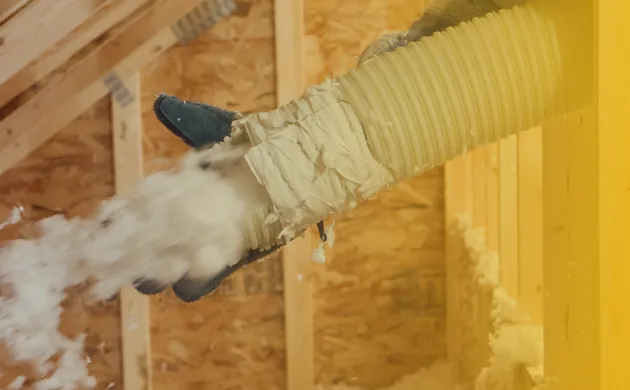
Most Maryland homes were insulated to the standard of the decade they were built in — and standards have moved. The attic that was "fine" in 1998 is quietly under-insulated today, and the gap shows up as upstairs rooms that never match the thermostat and a heating system that runs longer than it should. The good news: you do not need instruments to get a first read on your attic. You need a ruler, a flashlight, a dust mask and fifteen minutes.
Before you climb: the safety rules
Attics punish carelessness. Step only on joists or on boards laid across them — the drywall ceiling below will not hold your weight. Wear a mask and gloves: old insulation sheds fibers and dust, and blown material may hide ductwork, junction boxes and the ends of nails. Take a flashlight even at noon, and skip the trip entirely on a summer afternoon, when a Maryland attic can pass 130 degrees. If your attic has no floor and tight access, that alone is a reason to let a crew with boards and lights do the looking.
The measurement itself
Push your ruler or tape straight down through the insulation until it touches the ceiling drywall, and read the depth in three or four spots: near the hatch, mid-attic, and out toward the eaves. Depth means different things by material. As a rough field guide, blown fiberglass needs roughly 14–16 inches to reach the R-49 level recommended for our climate zone, blown cellulose about 13–14 inches, and fiberglass batts about 13–15 inches. The label on a batt, if you can find one, states its R-value directly. What matters most is not any single reading — it is the lowest one, because heat finds the thin spots first.
What else to look for while you are up there
Depth is only one chapter. Look for insulation that has been pushed aside around the hatch and never replaced, batts squashed flat by stored boxes (compressed insulation loses R-value), dark dust staining on the material around ceiling fixtures — the fingerprint of air leaks — and bare patches above bathrooms and kitchens, where penetrations cluster. Note any daylight visible at the eaves or water staining on the roof deck. Each observation points at a different fix, and most of them are cheaper than a full re-insulate.
Turning readings into a decision
If your depth is within an inch or two of target and even, you are in good shape — seal the hatch and leave it alone. If it is uniformly low, the economical fix is usually a blown-in insulation top-up over what you have, after air sealing the leaks the dust stains revealed. If it is patchy, matted, wet or contaminated, topping up is false economy and the conversation shifts to removal and replacement. Our attic insulation assessments measure the same way we just described — only with more spots checked, photos of everything, and the options priced in writing before anyone sells you an inch of material.
A note on honesty
Be suspicious of any depth reading taken by someone whose pay depends on the answer. Measure it yourself first, using this guide, and you will know whether the quote you get later matches the attic you actually have. Homeowners from Beltsville to Rockville call us every week having done exactly this homework — it makes for a short, honest conversation.
Want a second set of eyes? Call Eagle Insulation Services at (855) 640-0404 — the free assessment line is answered around the clock.
Want us to look at your attic?
Book a free assessment — depth measured, leaks photographed, options in writing.